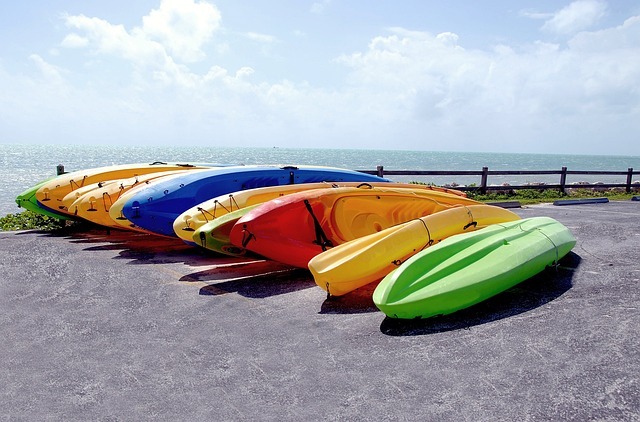
Which craft should you buy: a kayak, a canoe, or a paddle board? All of these options are excellent, depending on where, how, and with whom you want to paddle.
Summary
Advantages and disadvantages of kayaks
The kayak is ideal for those who prefer to handle their own craft or who often paddle alone. The double-bladed paddle gives you a lot of control, especially in wind and waves. Since you are sitting much lower than in a canoe, the kayak is very stable.
Good kayaks are designed to be an extension of the paddler’s body, allowing for very high performance in many different environments: whitewater, ocean surf, rivers, and large lakes. These are the most maneuverable and fastest craft on this list.
Sea kayaks are perfect for multi-day camping trips, provided there is no portaging. All your gear must be divided into small bags to fit in the compartments of your kayak, so you should get in and out of your kayak as little as possible.
If you want to fish from a non-motorized boat, the fishing kayak is your best choice. It is more stable than a canoe, you have the option to stand while fishing, and there is plenty of space for gear.
There is a wide variety of kayaks on the market, including sit-in kayaks, sit-on-top kayaks, and kayaks of all lengths. Children can share a tandem kayak with a parent or sit in their own small kayak and learn to paddle from a young age.
Advantages and disadvantages of canoes
One of the major advantages of canoes is that they can hold both people and gear. They are perfect for multi-day trips, whether on calm waters or rivers. If you love the idea of multi-day excursions with portaging, the canoe has no equal. They are designed for this type of excursion.
If you and your family want to be able to paddle on local lakes, you might all fit in one canoe, depending on how many of you there are and the ages of your children. This is why canoes are excellent recreational boats.
Canoes require more skill than kayaks to steer, so there is a steeper learning curve to develop your paddling skills. They are also higher in the water and thus not as stable, and they are more sensitive to the wind.
Advantages and disadvantages of SUPs
Stand-up paddle boards (SUPs) are not as stable as a canoe or kayak and are not as easy to use for multi-day excursions. They are also not as efficient on flat water, although they excel in surf. After all, the SUP originated on the surf waves of Hawaii.
SUPs are great for a family because one or two kids, or the family dog, can get on and move around. They also make excellent rafts for swimming; just jump on during a hot day to easily climb back aboard. You can’t do that as easily with a kayak or canoe!
If you’re looking to get a workout, paddle boarding is undoubtedly the best way to engage your whole body. The lower body is constantly working to maintain balance on the moving board, while the upper body is handling the paddling strokes. This is why SUP yoga is so popular.
Leave a Reply