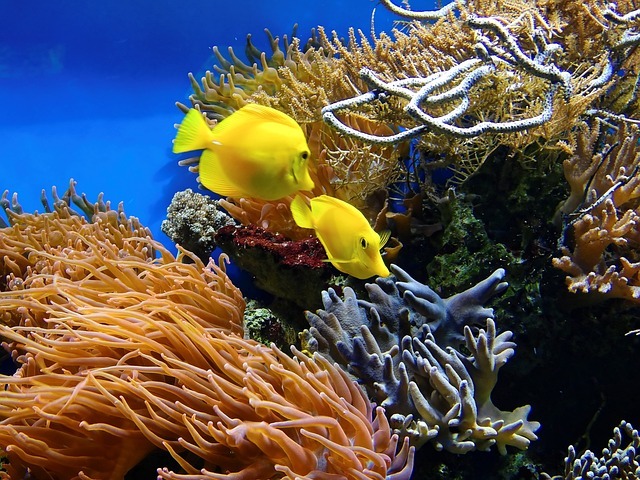
Often overlooked marine species, corals play a crucial role in maintaining the marine ecosystem. They come in various forms and are found at different depths of the sea. Corals exhibit a variety of shapes and their properties are equally diverse. This guide provides information about corals and their importance to the marine ecosystem.
Summary
What is a coral?
A coral is a marine species belonging to the class of cnidarians, which also includes jellyfish and other animals such as sea anemones. Corals are distinguished by their formation in limestone and their gathering in colonies that can be truly substantial in size.
Corals have a diet composed of small organisms including plankton and certain varieties of fish, which they capture using their tentacles and stinging cells.
They have a symbiotic relationship with a type of single-celled algae known as zooxanthellae, which are present within their tissues and provide most of their food in exchange for protection and nutrients.
What is the role of corals?
The importance of corals is undeniable as they play a significant role in building and maintaining the marine environment. Corals nourish and shelter numerous marine organisms but also serve other functions: Here are some of the roles fulfilled by corals in the marine environment:
- A shelter for fish and other organisms of the environment: Coral reefs serve as a habitat for many varieties of organisms such as fish, certain varieties of crustaceans, mollusks, and many other animals. These organisms live and find the necessary nutrients for their nourishment there.
- Protection against storms and waves: Coral reefs, due to their strength and shapes, also serve as a barrier by reducing the impact of waves and storms when they hit the shore. Coral reefs reduce their effect by absorbing part of the shock produced by the waves, thus protecting the coast.
- Protection against erosion: Corals, through their colonial formation, prevent waves from eroding the coast by reducing their impact force.
- Tourism and local economy: Coral reefs attract numerous visitors who come to study or observe them each year. This allows the region to generate revenues that can be used for activities at the communal or national level. In addition to the revenues generated, corals also provide a food supply for certain populations living near the coast.
In summary, corals are a vital element of the marine ecosystem and play an important role in protecting the coasts, providing habitats and food for many marine organisms, as well as supporting local economies.
The categories of corals
There are many types of corals that fall into various categories. Corals are classified into two main classes: soft and hard, and further study allows us to identify the following types of corals:
- The fringing coral reef: this is a category of coral that is most often found near coastlines.
- The barrier reef: this reef, as its name indicates, is found offshore and helps reduce wave impact.
- The platform reef: it is surrounded by expanses of water, whether oceans or seas.
Other categories of corals are classified as solitary, builders, and some even bear the name of false corals. It is worth noting that soft corals have a much easier time developing even if they do not have identical living conditions. Some prefer heat while others prefer cold climates.
The different types of corals
Now that the role of corals is understood, it is also appropriate to discover the organisms that make up this species.
The orange tubastraea coral
Known scientifically as Tubastraea coccinea, this coral belongs to the family Dendrophylliidae. Usually yellow, pink or orange, depending on the case, the orange tubastraea coral is found in the Pacific and Atlantic waters at depths of up to 37 meters and at temperatures ranging from 23 to 26 degrees.
This species of coral has a particular preference for dark places such as caves or the remains of sunken ships. Its diet consists of zooplankton and it is well known for its voracity as well as its size which can reach up to 10 meters.
The fire coral
The fire coral is a variety of coral found in tropical seas at depths of about 40 meters. Yellow or brown in color, this coral, also known as Millepora, feeds on plankton and can withstand temperatures up to 29 degrees.
The Millepora ranges in size from 30 to 60 cm and is classified as a venomous species. This substance secreted by the coral is harmful to the human body and can cause burns, redness, and vomiting for anyone coming into contact with it.
The red coral
The red coral, also called Corallium rubrum, is a variety of coral threatened due to its overexploitation for jewelry making. Also known as red gold, Corallium rubrum can reach a size of up to 20 cm and can tolerate temperatures of up to 15 degrees.
The red coral belongs to the family Coralliidae and is found at a depth of 400 meters in the Mediterranean and Atlantic waters. It is a species with a very varied diet, feeding practically on everything nearby. This can include plankton, copepods, crustaceans, or even eggs of other organisms present in its environment. This makes it one of the few in its species capable of feeding on various organisms.
The black coral Antipatharia
With a size of 1.8 meters, the black coral Antipatharia is known for its ability to live in cold waters (temperatures ranging from -65 to 10 degrees) and at extremely high depths. This coral lives at depths of up to 8,600 meters and inhabits Arctic and Antarctic waters.
Like the red coral, this coral from the Antipathidae family is also used in the jewelry making sector.
The blue coral
With a size of 1.5 meters, the blue coral scientifically called Heliopora coerulea is a species found in the waters of the Indian Ocean, the Pacific, French Polynesia, and in the waters of the southern African region. This coral from the Helophoridae family feeds on plankton and can tolerate temperatures of up to 20 degrees.
This variety of coral is sometimes confused with fire coral due to their similar traits: the absence of a limestone skeleton, although in its case the exact depth is not clearly defined.
The Acropora coral
This variety of coral, also known scientifically as Acropora, is found in the waters of the Pacific, Atlantic, and Indian Oceans. The Acropora coral can thrive at temperatures around 20 degrees and lives at a maximum depth of 50 meters.
The Acropora coral has a diet composed of zooplankton, resembles a small plant with many branched arms, and its color changes depending on the environment in which it is located.
The Euphyllia coral
The Euphyllia coral is a type of coral that has green and purple colors. It is certainly one of the most widespread varieties given the high number of environments in which it is found. The Euphyllia coral is scientifically named Caryophyllidae Euphyllia and is found in the following waters:
- The waters of New Caledonia;
- The waters of the Indian and Pacific Oceans;
- Those of the Fiji and Solomon Islands and
- Some waters in the western region of Africa.
This coral is about 1 meter in size and has a diet composed of single-celled algae and other organisms from the environment (fish and crustaceans). The Euphyllia coral lives at a maximum depth of 60 meters and is also referred to as golden torch due to the contrasting appearance of its colors.
Corals of marine species have both a nourishing and protective function. They come in various forms and have equally variable environments. Some varieties are harmful to the human body while others are edible.
Some varieties among them need to be protected due to their massive use in the jewelry making sector. Corals play an important role in the balance of the environment even though they appear to be organisms of little importance.
Leave a Reply